Capture
2–5 cameras around the people doing the task. Drones outdoors. No markers or installation.

Autelica
Markerless 3D capture of people at work, from 2–5 ordinary cameras or drones. Delivered retargeted to your robot and validated in physics.
Watch
From a few ordinary cameras to measured 3D of hands, body and terrain, retargeted onto robots and checked in physics simulation. Pick a chapter or play all 2:23 (captions, no sound needed).
Robot shots are physics simulation. Hand footage includes the HO-Cap dataset (CC BY 4.0). Plays from YouTube.
Field result
The gap
Pilot
2–5 cameras around the people doing the task. Drones outdoors. No markers or installation.
Sync and calibration from the footage itself. Metric 3D body and hands. Held-out-camera grading.
Retargeting to your robot, contact checks, physics tests under randomized disturbances.
Motion, policies and an evaluation report per site, in LeRobot, HDF5 or JSON.
Customers
Quality control
Each clip is reconstructed with one camera excluded, then compared with that camera’s footage. The residual, in pixels and millimetres, ships with the clip.
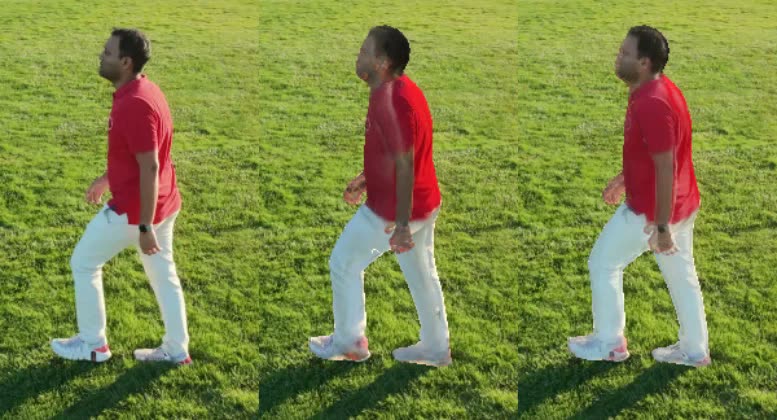 Drone footage
FAQ
Metric 3D body and hand motion of people performing a task, captured on site with 2–5 ordinary cameras or drones, retargeted to your robot and validated in physics simulation.
No. Cameras are synchronized and calibrated from the footage itself. No markers, suits or calibration targets.
Body joints: about 52 mm against a three-camera outdoor reference (ASPset-510). Hands: 17–19 mm at about 2 m (Harmony4D, evaluation only). Camera sync: 1.2 ms median. Every clip includes a held-out-camera error report.
Unitree G1 (29 DoF) today. Other embodiments are scoped per pilot.
Source video, camera calibration, 3D body and hand keypoints in metres, error report, retargeted robot trajectory and physics-validation results. LeRobot, HDF5 or MP4 with JSON.
One site and one task. About 4 hours on site with 2–5 people who perform the task; robot-ready motion and an evaluation report in about two weeks.
Not yet. Results to date are in MuJoCo with randomized pushes, friction and control latency. Hardware validation is next.
Written consent from every subject, optional face and screen blurring, and on-premises processing for sensitive sites.
Founder Rohan Rao co-authored the IROS 2021 paper from Carnegie Mellon’s AirLab on 3D human reconstruction with collaborating aerial cameras. Based in San Francisco.