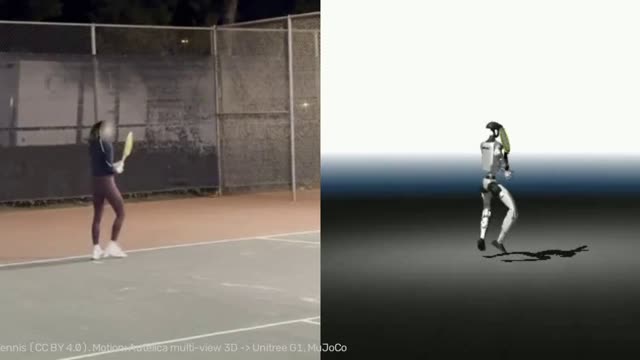
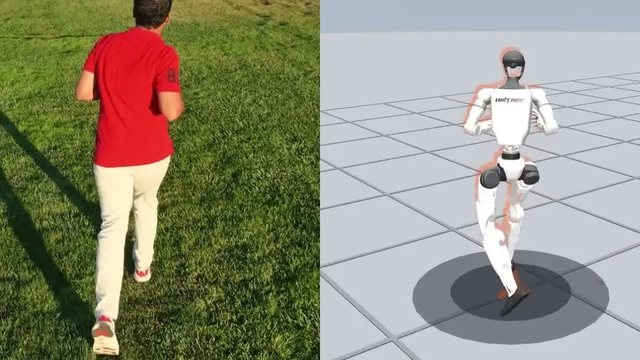
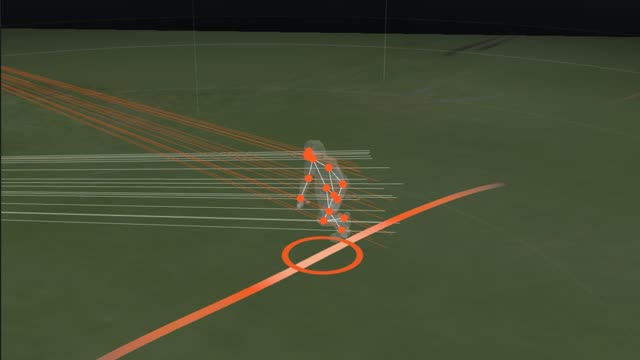
AutelicaResearch

Research and captures.

Every capture we have recorded and every study built on them, in one place. Each card gives the date, the key numbers and a link to the full write-up, with the protocol behind every number. Robot results are from physics simulation unless a page says otherwise.

4 captures11 studies5 benchmarksUpdated

Search all researchAsk our research

Benchmark · · public data

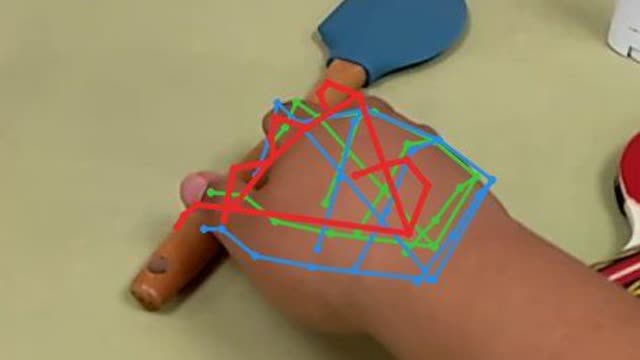
Hand labels: fixed cameras vs head cameras

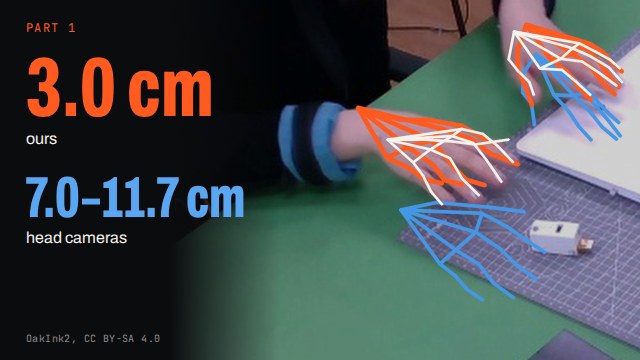
We measured how far each method’s hand labels land from the real hand, with marker motion capture as the reference and no alignment, then replayed the labels with a robot hand in a physics simulation.

  • Our three fixed cameras: 3.0 cm from the real hand.
  • Published head-camera methods, given the camera’s true pose: 7.0–11.7 cm.
  • Robot task success in the replay: 0.25 from our labels, 0.19 from WiLoR’s and 0.41 from the motion-capture reference.

Head-camera methods still do better on hand shape and coverage, and come close on the benchmark’s aligned metric; the page says where.

0255075100125150Ours: three fixed cameras: 30.2 mm with no alignment, 22.1 mm W-MPJPE (aligned once per clip), coverage 0.74 Ours: three fixed cameras 30.2 Ours: three cameras, no learned part: 32.6 mm with no alignment, 24.0 mm W-MPJPE (aligned once per clip), coverage 0.73 Ours: three cameras, no learned part 32.6 WiLoR + given head poses: 69.5 mm with no alignment, 29.8 mm W-MPJPE (aligned once per clip), coverage 0.95 WiLoR + given head poses 69.5 HaWoR, given head poses: 116.7 mm with no alignment, 51.2 mm W-MPJPE (aligned once per clip), coverage 0.99 HaWoR, given head poses 116.7 Ours, head camera only: lifter: 76.8 mm with no alignment, 36.2 mm W-MPJPE (aligned once per clip), coverage 0.71 Ours, head camera only: lifter 76.8 Placement error with no alignment, mm (what a robot receives)050100150Ours: three fixed cameras: 30.2 mm with no alignment, 22.1 mm W-MPJPE (aligned once per clip), coverage 0.74 Ours: three fixed cameras 30.2 Ours: three cameras, no learned part: 32.6 mm with no alignment, 24.0 mm W-MPJPE (aligned once per clip), coverage 0.73 Ours: three cameras, no learned part 32.6 WiLoR + given head poses: 69.5 mm with no alignment, 29.8 mm W-MPJPE (aligned once per clip), coverage 0.95 WiLoR + given head poses 69.5 HaWoR, given head poses: 116.7 mm with no alignment, 51.2 mm W-MPJPE (aligned once per clip), coverage 0.99 HaWoR, given head poses 116.7 Ours, head camera only: lifter: 76.8 mm with no alignment, 36.2 mm W-MPJPE (aligned once per clip), coverage 0.71 Ours, head camera only: lifter 76.8 Placement error with no alignment, mm (what a robot receives)

mean placement error, no alignment

Placement against marker motion capture (OakInk2), no alignment. Coverage: ours 74%, WiLoR 95%.
Study · · from capture 03

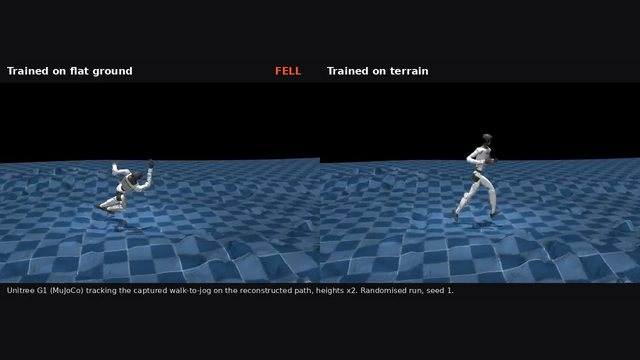
A G1 trained on the measured terrain fails fewer clips

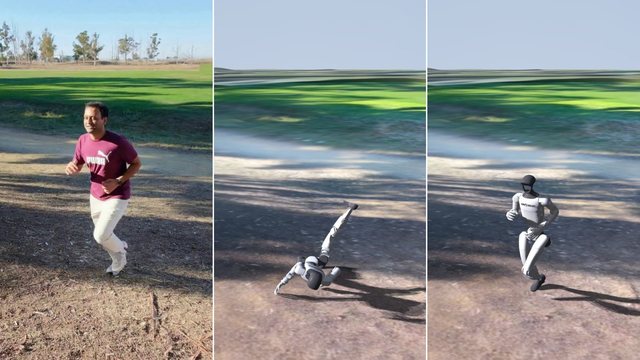
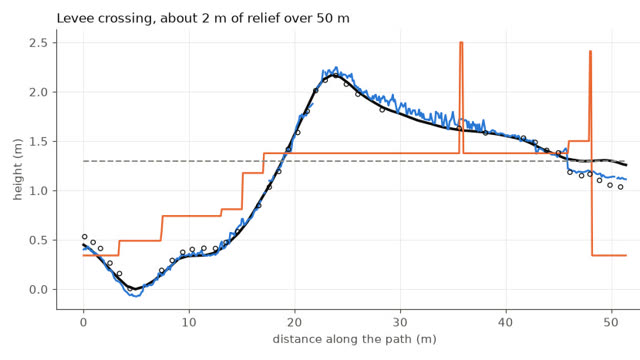
A Unitree G1 tracking policy trained on the same 210 four-second clips of one person on park slopes and a levee (Capture 03), with world-model training in the style of SuperMimic (Liao et al., CoRL 2026, arXiv 2610.28480): 6,400 iterations, 3 seeds per arm, both arms tested on the measured terrain and every clip evaluated 5 times. Trained on a flat floor, the robot failed about 31 of the 210 clips (14.6%, 95% CI 10.5–19.0). Trained on the measured terrain, it failed about 12 (5.6%, 3.0–8.6). On a larger, overlapping set of 323 clips the direction held with a smaller gap (9.9% vs 15.6%, confidence intervals touching).

The terrain is measured from the drone video where the drones saw the path (about 4 cm from survey lidar at the 90th percentile, on those stretches) and taken from public USGS lidar elsewhere, which covers the path on 148 of the 210 clips. Physics simulation only, one person and short clips. No real-robot runs.

Read the study
Everything

Eight desk tasks seen by four camerasCapture 04
Capture 04 · · Hands + objects

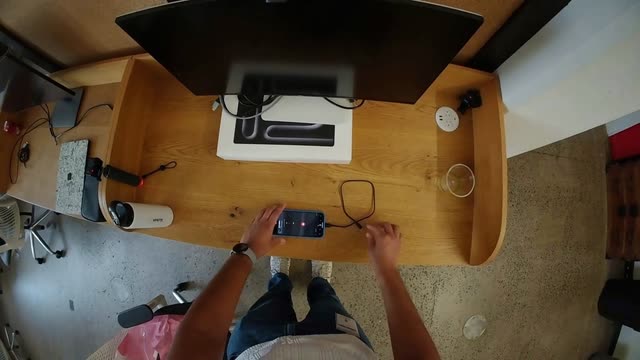
Eight desk tasks seen by four cameras

USB-C plugs, a mount screw, a laptop, batteries, boxes and a bottle, filmed by a head camera and three fixed cameras with no shared clock.

  • 11.0–13.8 mm cross-view hand error on 6 of 8 tasks
  • 10.4 mm true hand error for the same camera layout on HO-Cap
  • 4 views with object masks, head camera included
Open the capture
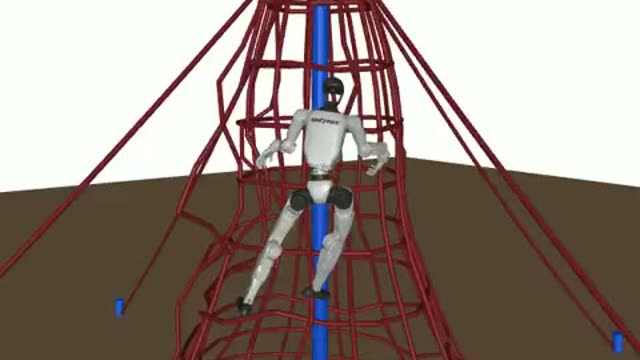
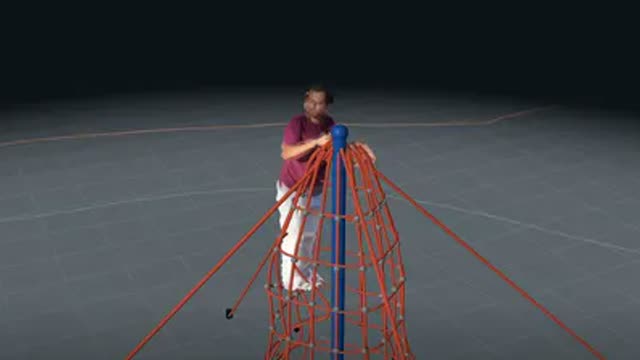
Slopes, step-ups and a rope-net climbCapture 03
Capture 03 · · Terrain + climbing

Slopes, step-ups and a rope-net climb

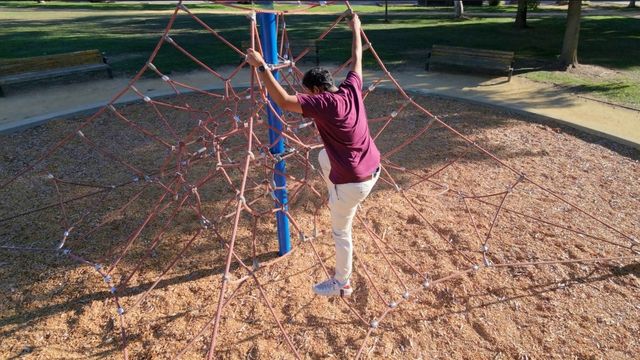
One afternoon of walking, climbing and step-ups in a park, filmed by three drones and cut into 86 labelled windows.

  • 24,315 frames of measured 3D body motion
  • 10 cm ground error against survey lidar on the slopes (p90)
  • 85.8% of G1 policy runs finished across 233 clips (sim)
Open the capture
Running and cycling, filmed by three dronesCapture 02
Capture 02 · · Running + cycling

Running and cycling, filmed by three drones

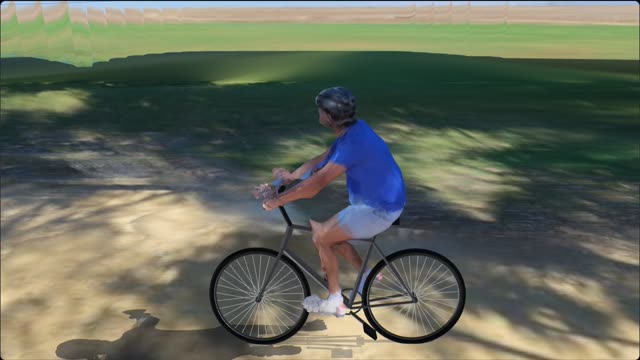
A cyclist on dirt trails and a runner on paths, filmed at 30 and 100 fps, with each drone’s clock recovered from the motion.

  • 19.1 min with all three drones recording, in 4 takes
  • 2.9 s clock offset of one drone, found from the motion
  • 14 mm body error against the triangulated joints, cleanest window
Open the capture
Three consumer drones, one runner, no shared clockCapture 01
Capture 01 · · Running

Three consumer drones, one runner, no shared clock

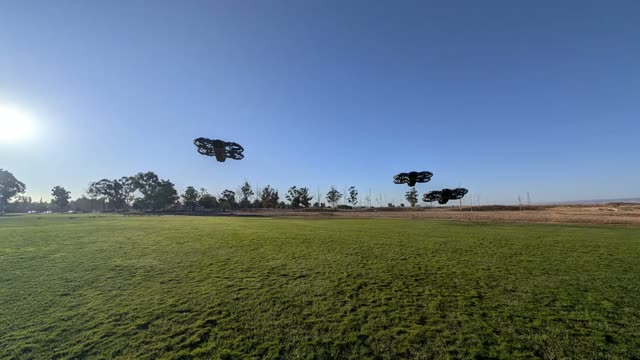
One person walking, jogging, sprinting and turning in a park, filmed by three consumer drones on factory settings.

  • 15.4 min with all three drones recording, in 6 takes
  • 0.3° camera orientation error against the drones’ own logs
  • 59 of 59 Unitree G1 runs of the sample jog without a fall (sim)
Open the capture
A G1 trained on real ground fails less
Study · · from capture 03

A G1 trained on real ground fails less

We trained a Unitree G1 on the measured ground of a park and on a flat floor, then tested both on the measured ground in simulation.

  • 5.6% of clips failed after training on the measured ground
  • 14.6% failed after training on a flat floor
  • 210 test clips, each run 5 times
Read it
Hand labels: fixed cameras vs head cameras (Part 1)
Benchmark · · public data

Hand labels: fixed cameras vs head cameras (Part 1)

How far hand labels land from the real hand, measured against marker motion capture, and what that does to a robot hand in a physics replay.

  • 3.0 cm ours, placement with no alignment
  • 7.0–11.7 cm head-camera methods, given the true camera pose
  • 74% our coverage; WiLoR 95%
Read it
What hand-label error does to robot policies (Part 2)
Study · · public data

What hand-label error does to robot policies (Part 2)

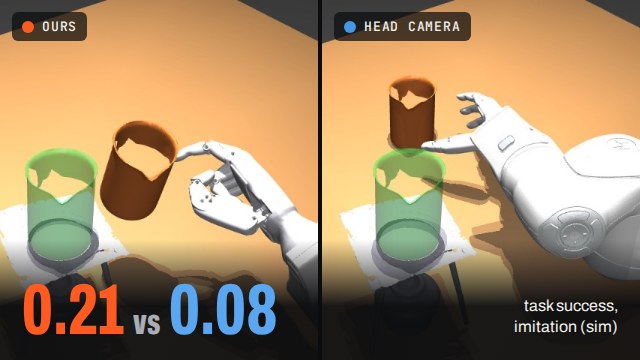
Robot-hand policies trained on each source of hand labels and tested from the same held-out starts on three OakInk2 tasks, in simulation. Our labels beat both head-camera methods on two of them.

  • 0.21 vs 0.08–0.12 pick-and-place imitation success in simulation, ours vs head-camera labels
  • 2 of 3 OakInk2 tasks where ours beats both head-camera methods
  • 0.47 vs 0.29–0.31 after longer reinforcement learning, in simulation
Read it
Processing a whole afternoon, not just highlights
Benchmark · · from capture 03

Processing a whole afternoon, not just highlights

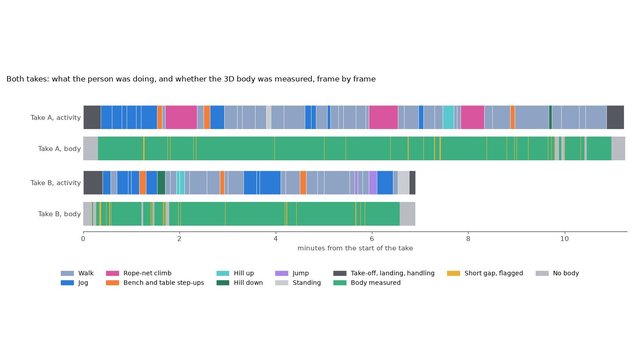
Two whole takes of three-drone footage, 18 minutes, with every frame flagged as measured, a short gap or no body.

  • 87.1–90.6% of frames have a measured 3D body
  • 95% of the frames that two drones can see
  • 90–99% per activity, take-off and landing aside
Read it
Erasing bystanders instead of blurring them
Study · · from capture 03

Erasing bystanders instead of blurring them

How we remove other people from published drone footage, then check every frame for anyone left.

  • 4,517 frames re-checked after the erase
  • 12 spots flagged by the final check, none of them a person
  • 18% of clip time cut rather than blurred
Read it
Measured vs inferred ground on real slopes
Benchmark · · from capture 03

Measured vs inferred ground on real slopes

Ground measured from drone video and ground inferred from motion alone, both scored against USGS survey lidar at the foot contacts on four slopes.

  • 10 cm error for ground measured from video (p90)
  • 70 cm for ground inferred from motion (p90)
  • 3 cm median error, measured ground
Read it
Can a simulated humanoid climb a rope net?
Study · · from capture 03

Can a simulated humanoid climb a rope net?

One captured rope-net climb moved onto a Unitree G1, first kinematically and then in physics, with and without support.

  • 7–9% of hold frames with a limb off the net, down from 69–88%
  • 6 of 6 climbs finished with support up to body weight (sim)
  • 0 of 6 finished with half that support
Read it
Benchmark · · from capture 03

How long processing takes

Raw footage to synced cameras, whole-take 3D body and quality checks, timed as a multiple of the footage length.

  • 1.20–1.40× the footage length for whole takes
  • 0.18× for the on-site check after landing
  • 1 GPU on one shared workstation
Read it
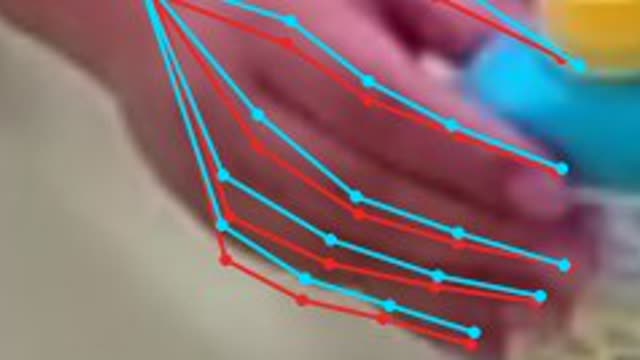
Head-camera hand labels from outside cameras
Study · · public data

Head-camera hand labels from outside cameras

One head-camera hand model trained on four label sources and scored on people it never saw, on the public HO-Cap dataset.

  • 24.3 mm error with labels from 4 outside cameras
  • 23.2 mm with ground-truth labels
  • 64 mm with head-camera labels alone
Read it
3D hands from a few cameras
Study · · public data

3D hands from a few cameras

Hand joints triangulated from a few ordinary cameras, tested on people the models never saw in the public HO-Cap dataset.

  • 5.4 mm median joint error with 8 cameras
  • 5.6 mm with 4 cameras
  • 9.9 mm with off-the-shelf keypoints
Read it
Terrain from capture to robot policy
Study · · from capture 02

Terrain from capture to robot policy

A dirt path rebuilt from the same drone clip as the motion, then a G1 trained on it in simulation.

  • 10 mm median ground error against a held-out drone
  • 196 of 200 runs stayed up for the terrain-trained G1
  • 128 of 200 for the flat-trained G1
Read it
Does camera count change robot training?
Study · · public data

Does camera count change robot training?

The same motion captured by a 27-camera dome, three cameras and one camera, then tracked by a G1 in simulation.

  • 12.9 cm G1 keypoint error from three cameras
  • 12.3 cm from the 27-camera dome
  • +3–6 cm from one camera
Read it
Five ways retargeting to a G1 goes wrong
Study ·

Five ways retargeting to a G1 goes wrong

The failure modes we hit moving captured human motion onto a humanoid, and the checks that catch each one before training.

  • 5 failure modes, from start-up transients to floating feet
  • 29 DoF Unitree G1, checked in MuJoCo physics
Read it
Study ·

Why handheld video broke our camera solve

A camera-path solve failed about 3 runs in 10 on handheld phone video; this is what we ruled out and what fixed it.

  • 3 in 10 runs failed before the fix
  • 3 min first try after the fix
  • 6–10 min per replay before it
Read it
Benchmark · · public data

Accuracy on public benchmarks

Every accuracy number we publish, each with its dataset, reference and date.

  • 1.2 ms median camera sync error on 35 public clips
  • 52 mm body joint error in outdoor sports
  • 17–19 mm hand error at about 2 m
Read it
Syncing cameras without timecode
Study · · public data

Syncing cameras without timecode

Lining up cameras that share no clock, first from sound and then from the subject’s own motion.

  • 1.2 ms median sync error
  • 35 public clips tested
Read it

Ask our research

Questions about our captures, benchmarks and studies. Answers come from the pages on this hub and link to where each point is made.

0 / 500

Answers are generated from our published research and may be imperfect.